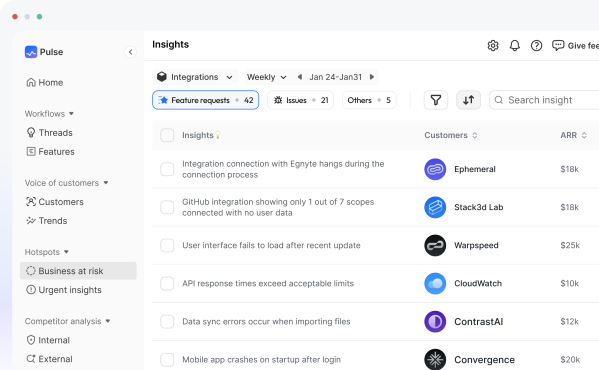
The Power of Unified Customer Feedback: Turn Signals Into Strategic Action
Introduction
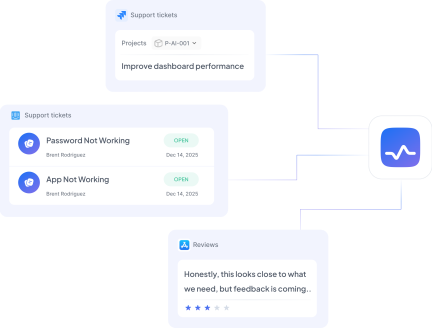
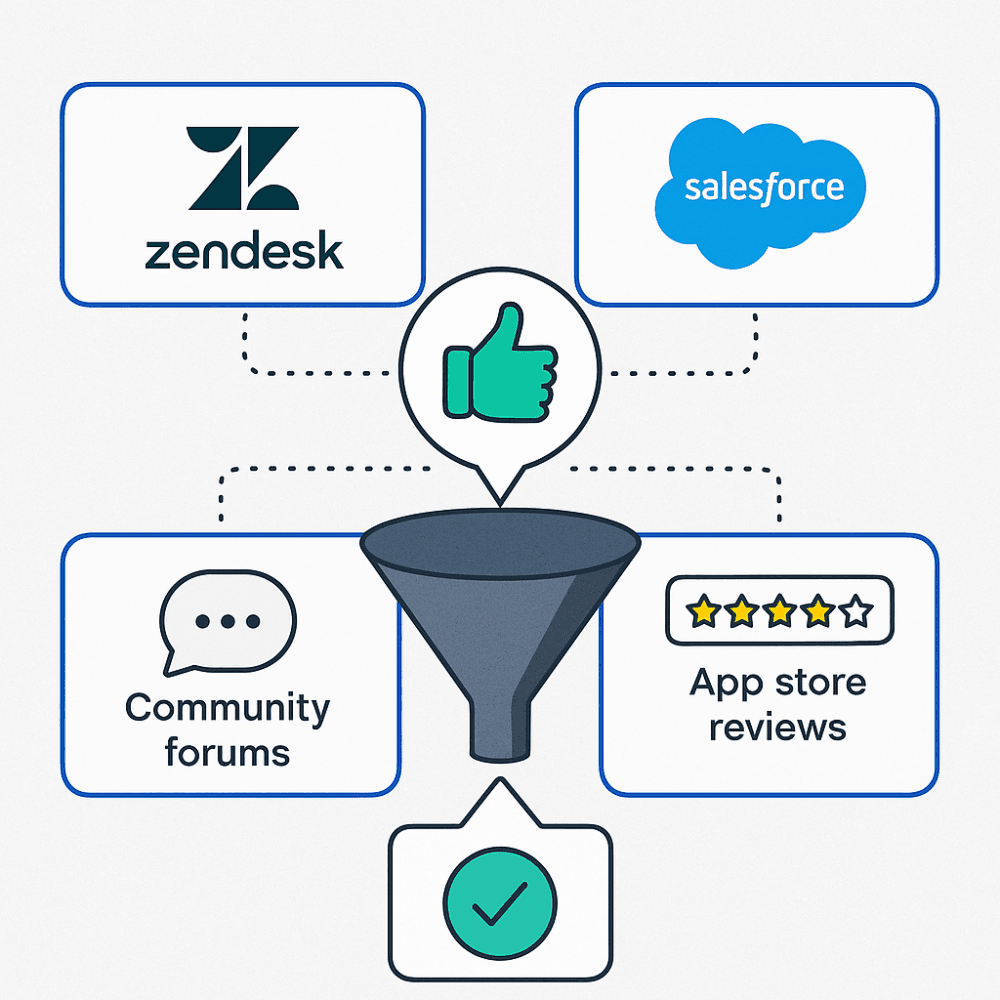
Every product, support ticket, app review, and social post holds a clue about what your customers truly need. But when those clues live in silos across Zendesk, Salesforce, call transcripts, app stores, community forums and spreadsheets, they become noise. The result: missed product bets, slow CX fixes, and operational surprises that show up as churn or lost revenue.
Centralising customer feedback isn't just a tidy data problem. It's a competitive advantage. When you bring all sources of feedback together, enrich them with business context, and automate the move from insight to action, teams stop guessing and start executing on what actually moves the needle.
Why Fragmented Feedback is an Enterprise Problem
Each channel by itself is useful; together, they tell the whole story. But most organisations haven't connected the dots, so insights rarely translate into action.
Research and industry reports show this gap: voice-of-customer (VoC) programs and feedback management teams often struggle to turn data into decisions and measurable outcomes. That means stakeholders don't act, and the loop between customer signal and business response remains open.
"Modern VoC goes beyond surveys; it must collect, analyse, and convert customer interactions from many sources into operational insights. That's why centralisation is table stakes for any company that wants to be customer-led."

What Centralised Feedback Actually Delivers
When feedback is unified and enriched with business context (account value, segment, region, product line), organisations can spot high-impact issues before they cascade, prioritise actions by business value rather than by the loudest voice in a meeting, close the loop with customers and show that their input led to real change, and connect CX signals to product adoption and revenue outcomes so investments are measured and defensible.
Put simply: centralisation converts passive signals into proactive business outcomes.
Why AI Agents Are the Accelerant
Centralising feedback at scale used to be a technical and human nightmare. Today, AI—and specifically agentic AI—changes the equation. AI agents can continuously ingest millions of unstructured items, normalise language across sources, cluster similar issues, surface anomalies, and even recommend the next operational step.
Leading research on AI agents highlights how these systems can dramatically improve operational effectiveness in CX and related functions, speeding up detection, reducing cost-to-serve, and enabling more personalised responses at scale. In short, AI agents make real-time feedback intelligence realistic for enterprises.
How the Best Teams Implement Unified Feedback
- Ingest everywhere — connect support, CRM, call recordings, app stores, social, community, and product analytics
- Normalise & dedupe — clean text, remove duplicates, and map synonyms to unified concepts
- Enrich with context — tag items with account ARR, customer segment, region, product area, and lifecycle stage
- Prioritise by impact — score items by revenue exposure, churn risk, or repeat-order impact, not just volume
- Automate workflows — generate executive summaries, create ops tickets, or draft product asks automatically
- Close the loop — report back to customers or accounts, and measure downstream impact (NPS, CSAT, retention)
This is how companies turn feedback into a business function, not just a reporting exercise.
How Pulse Fits in the Ecosystem
There's no shortage of tools that help with parts of this problem. Where the field is evolving—and where we focus at Pulse—is on connecting insight to action at scale:
Unified ingestion + business scoring: not just "what customers say", but "what it means for revenue, retention and operations." Agentic workflows: automated playbooks that route issues, trigger remediation, or create product items based on business impact. Cross-functional focus: product, CX, and ops get tailored outputs—PRD drafts for product teams, escalation playbooks for CX, and operational triggers for logistics or fulfilment. Traceability and governance: full audit trails so leaders can see why a decision was made (essential for regulated or enterprise buyers).
In short: we aim to move organisations from "insights" to "decisions"—in minutes, not months.
Real Benefits to Expect
When you centralise feedback and operationalise it, leadership sees concrete outcomes: faster, evidence-led prioritisation across product and CX; reduced time-to-resolution for critical customer problems; improved customer retention and higher lifetime value because the right fixes reach the right customers faster; and better ROI on product investment because roadmap decisions are tied to measurable business outcomes.
Industry analyses repeatedly show that tools and practices that close the loop on customer feedback are the ones that unlock measurable value—not simply more dashboards.
Common Pitfalls — And How to Avoid Them
- Treating this as a tooling project: centralisation requires operating-model changes—who owns signals, how decisions are made, and how impact is measured
- Ignoring security & governance: ingesting customer communications must meet enterprise compliance (privacy, auditability)
- Over-automation without human-in-the-loop: AI should accelerate human decisions, not replace accountability
- Not closing the feedback loop: customers must see results, otherwise trust erodes and programs lose momentum
Why It Matters Now
We're at an inflexion point: the volume of customer signals has exploded, and AI now makes it possible to process that data in real time. Organisations that centralise feedback, tie it to business context, and automate the journey from signal to action will outpace those that treat feedback as a backlog.
If you're building a product or running CX at a digital-first company—whether SaaS, consumer internet or D2C—centralising feedback is no longer optional. It's how you turn customer voices into a competitive advantage.
Learn how leading teams turn feedback into actionLearn How Leading Teams Turn Feedback Into Action

Analyse: Turning Customer Signals into Root Causes (Not Just Themes)Analyse: Turning Customer Signals into Root Causes (Not Just Themes)
Most companies don't lack customer data. They lack understanding. Every day, signals pour in from support tickets, sales calls, app reviews, NPS responses, and internal escalations. Teams know issues exist. They can even list them. But knowing what customers said is not the same as knowing what's actually happening.Most companies don't lack customer data. They lack understanding. Every day, signals pour in from support tickets, sales calls, app reviews, NPS responses, and internal escalations. Teams know issues exist. They can even list them. But knowing what customers said is not the same as knowing what's actually happening.
23 Mar 202623 Mar 2026
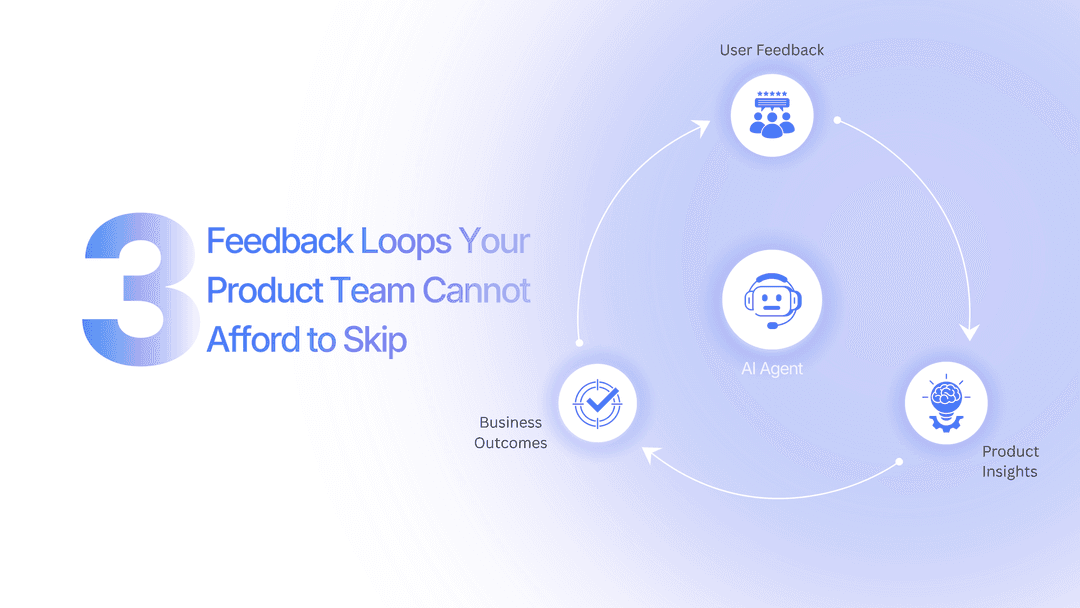
Agentic Feedback Loops: The Hidden Foundation of Autonomous AIAgentic Feedback Loops: The Hidden Foundation of Autonomous AI
Autonomy introduced prematurely becomes the fastest route to eroded trust. Learn why feedback loops must be sharper than your models, and how to build them before activating autonomy.Autonomy introduced prematurely becomes the fastest route to eroded trust. Learn why feedback loops must be sharper than your models, and how to build them before activating autonomy.
19 Mar 202619 Mar 2026
Security & Compliance You Can Trust


Security & Compliance You Can Trust
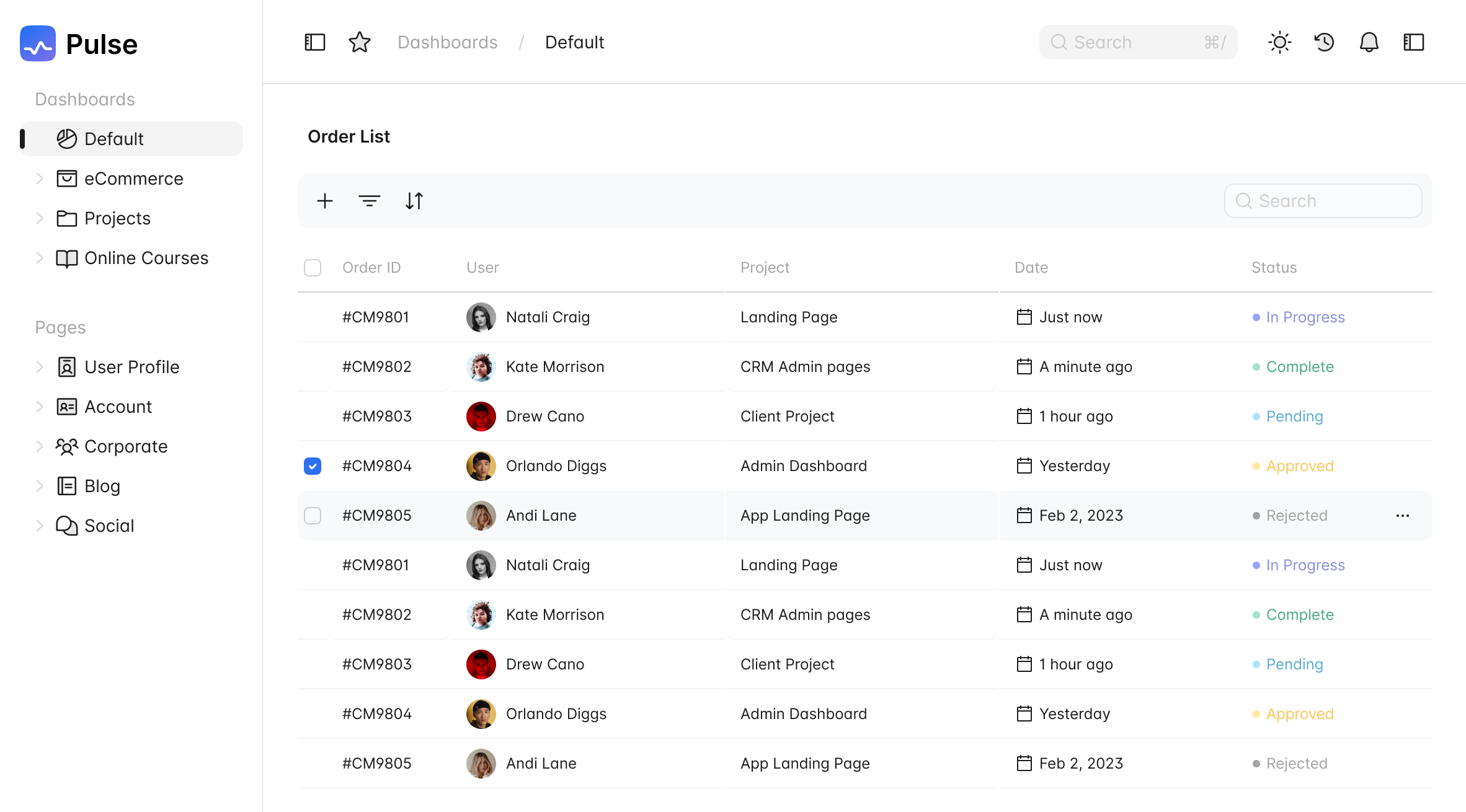
See how Pulse works with your data
Book a Demo